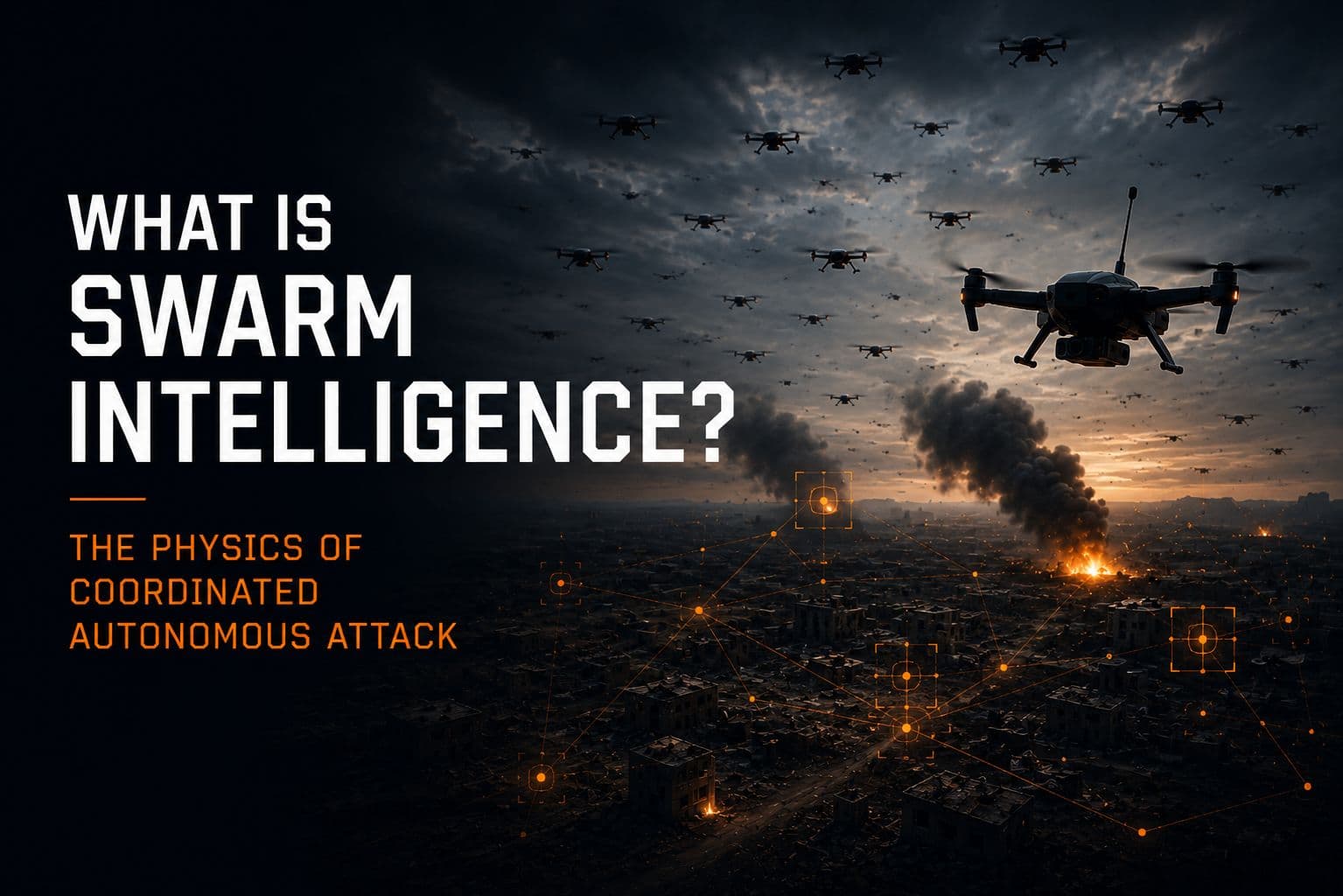
To defeat a drone swarm, you have to understand what makes it intelligent. The answer comes from biology, and it explains why there is no single node to attack.
Executive Summary
- Swarm intelligence is collective behaviour that emerges from simple agents following shared rules, no central controller required.
- In nature it produces flocks and colonies; in warfare it produces drone swarms that coordinate without a single command node to target.
- Because the intelligence is distributed and emergent, it must be defeated as a system, which is precisely what HokuQ is built to do.
Swarm intelligence is a concept borrowed from nature: the collective behaviour that emerges when many simple agents follow shared rules without central control. A flock of birds, a colony of ants, a school of fish, each exhibits coordinated, adaptive behaviour that no individual member directs. The intelligence is in the system, not in any one agent.
This is the principle that makes autonomous drone swarms so formidable, and so different from conventional threats. Understanding swarm intelligence explains why a swarm has no single command node to target, why it self-corrects, and why it must be engaged as a system rather than as a set of parts.
The Concept, From Nature to Machines
Swarm intelligence is collective, adaptive behaviour that emerges from simple agents following shared rules, with no central controller directing them.
In a flock or colony, each member follows simple local rules, and coordinated global behaviour emerges from their interaction. No bird leads the flock; the pattern arises from the system. This is swarm intelligence: capability that is emergent and distributed rather than directed.
Engineers have applied the same principle to machines. A drone swarm built on swarm intelligence coordinates through shared rules and local interaction, producing group behaviour without a central command node.
Why This Removes the Target
Because swarm intelligence is distributed, there is no central command node to target, the very thing conventional defense seeks does not exist.
Conventional military thinking looks for the command node: the head that, removed, defeats the body. Swarm intelligence has no such head. The coordination is distributed across the group and emerges from interaction, so there is no single point whose removal collapses the system.
This is why the swarm frustrates conventional defense at a conceptual level. The defender is looking for a target that, by the swarm's design, does not exist as a discrete object.
Why It Self-Corrects
Emergent coordination means the swarm adapts to losses automatically, the behaviour reorganises because no single agent was holding it together.
Because the swarm's behaviour emerges from the group rather than a controller, removing agents does not break it. The remaining agents continue following the shared rules, and coordinated behaviour re-emerges. The swarm self-corrects as a natural consequence of how swarm intelligence works.
This property, so useful in nature, is exactly what makes the military swarm resilient to attrition. Self-correction is not a feature bolted on; it is intrinsic to the intelligence.
How Swarm Intelligence Is Defeated
A system whose intelligence is emergent must be defeated at the level of the coordination itself, disrupting the rules and interaction that produce the behaviour.
If there is no command node and the swarm self-corrects, the swarm can only be defeated by disrupting the coordination that produces its collective behaviour, the layer where the shared rules and interaction live. Engage that, and the emergent intelligence collapses.
HokuQ is built precisely for this: disrupting the AI coordination layer where swarm intelligence resides. Understanding the physics of the swarm leads directly to the doctrine for defeating it, at the system level, not the airframe.
Understand the swarm to defeat the swarm. Request a HokuQ doctrine briefing.