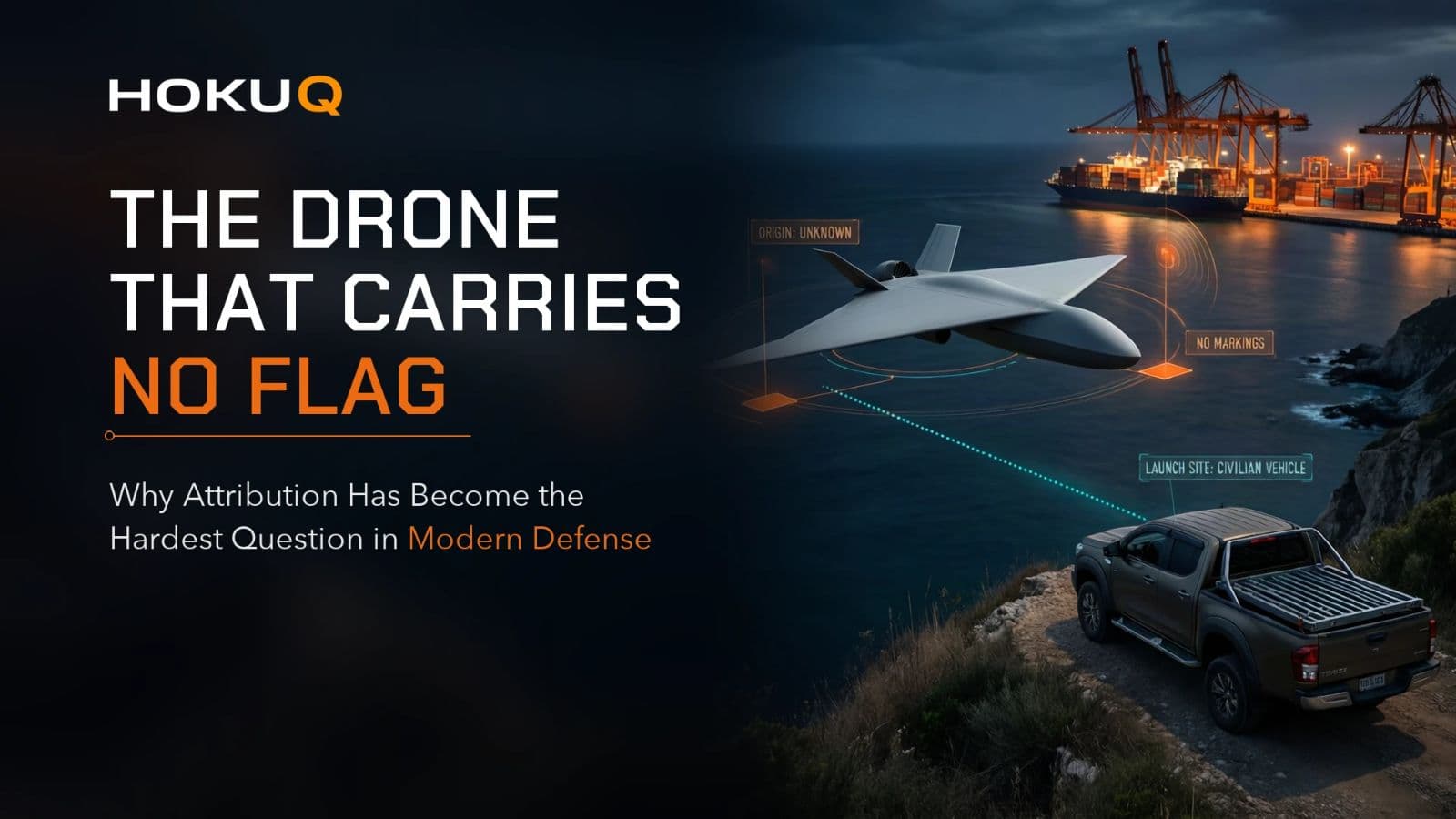
Why Attribution Has Become the Hardest Question in Modern Defense
For most of history, an attack announced its author.
Armies wore colors. Aircraft carried markings. Missiles left signatures that told investigators where they were built and who had fired them. Retaliation was possible because responsibility was knowable.
The autonomous era has severed that link.
A Weapon Without a Sender
A commercial airframe, assembled from components sold in a dozen countries, carries no nationality.
It launches from a truck, a boat, or an open field. It arrives without a pilot, transmits nothing, and leaves behind wreckage that anyone could have purchased.
The question after the strike is no longer how it happened. It is who.
Deniability Is Not a Side Effect
Ambiguity is not an accident of these systems. It is one of their most valuable properties.
An actor who can strike without being named can impose costs without inviting consequences. Undersea infrastructure has already demonstrated how well this works: the damage is done, the investigation opens, and attribution remains unresolved long after the disruption is complete.
Deterrence depends on the promise of a response, and a response requires a name. An adversary who cannot be identified cannot be deterred.
Attribution Has Become an Analytical Discipline
Attribution is no longer forensic work performed on wreckage. It is intelligence work performed on behavior.
Machines have habits. The way a swarm distributes tasks, recovers from losses, spaces itself, and adapts under pressure is a fingerprint of the intelligence that designed it.
Serial numbers can be removed. Reasoning cannot.
Recognition Requires Memory
A defense that treats every incident as isolated learns nothing from any of them.
Patterns only become visible across events, which means attribution depends on what an organization retained long before the attack that made it matter.
Only an organization that remembers can recognize.
The HokuQ Perspective
At HokuQ, we believe attribution in the autonomous era will be won by understanding behavior, not by recovering fragments.
The machine can hide where it was made. It cannot hide how it thinks.
The next weapon will not arrive carrying a flag. It will arrive carrying a pattern, and only the nations able to read patterns will be able to say a name out loud.